Showing posts with label interaction. Show all posts

Thursday, March 12, 2009

back of a digital napkin

SketchCast is based on an old principle: the improvised drawing on the back of a napkin in a bar, to sketch ideas and thoughts on paper to get a concept across another person. The website presents a new way to communicate "something" online by recording a sketch, with the option to overlay the animation with a voice or speech. Any sketch can be embedded on a blog or home page for later playback.


Can this be used as a storytelling method for designers? Or indeed, can it be used by users to communicate their ideas with designers?


Friday, February 20, 2009

visualizing networks

Going back to my research into visualizing complex information; Burak Arikan, artist and researcher, studies the way people interact through communication.

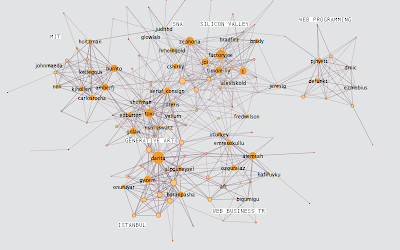
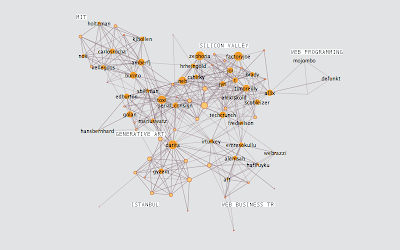
This following piece of work is wonderful. He carried out an experiment with the Twitter API where he analyzed the growth of his own network over a period of 3 weeks.

week 1

It appears he was trying to figure out how connections might evolve and expand (or indeed contract) over time.

The above image (from his blog) shows his Twitter network during the start of the first week of his experiment. He mapped the connections between his friends and then broke people into 6 groups.

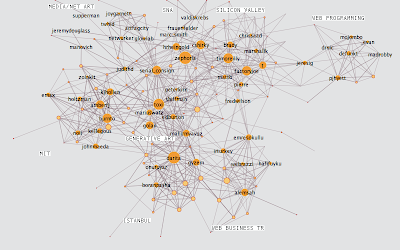
The next images show weeks 2 and 3:


Do people mind about these diagrams? It may reveal a lot about their privacy, which is potentially dangerous when you consider all the data is public.

I was thinking about carrying out a similar experiment with people within a work environment for the benefit of my research. Who talks to who in the office? In which way do they communicate (email, in person at the water cooler, telephone)? 

Communication can be a problem in the office. Bottlenecks can be created; It is also known for people to communicate through email, even although they sit next to one another. 

Where can ubiquitous computing come into all this? Can there be an invisible communication tool in the work place that can seamlessly fit into the daily rituals and lives of the employees?

It is naive and simplistic to consider ubiquitous computers will be adopted by people in any scenario. It's all about designing around the people.


Thursday, February 19, 2009

livescribe

Amazing IC product, livescribe.


Here's a quick demonstration by IIT Institute of Design professor Tom MacTavish, of the Livescribe digital writing system, a pen-and-paper duo that records audio, remembers what was being said while you were taking notes, and affords some basic computing function in a wholly analog format. If that sounds confusing, just check out the video; MacTavish does a great job of showing it off.


Wednesday, February 18, 2009

how romantech

An example of personal technology?

User interface designer Bryan Haggerty, programmer at LinkeIn, proposed to his girlfriend Jeannie Choe, former writer at Core77, with an iPhone application which he deigned himself.

It was last week that he popped the big question, but only after having his girlfriend guided through a route in San Francisco by the iPhone app. 

The app, which Haggerty calls "Romantech", displays a map containing location points throughout San Francisco. Each of the points in the map were tagged with a short video clip of Haggerty giving little clues of where Choe should travel to next. 


After a while, both met in a Park where all the points on the map connected to form the shape of a <3>

(The <3 is a heart symbol for those of you who don't know the lingo)>


Thursday, February 12, 2009

interactive comics and biological consideration

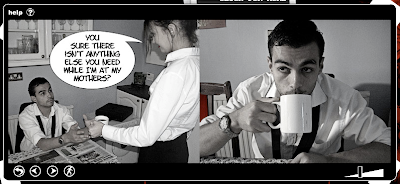
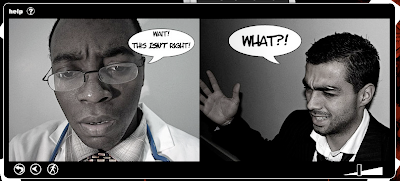
Dead On Arrival is an interactive comic loosely based on the story of the old 1940s film noir. 

Although I found this story rather dull, indolent and unexciting, the story was delivered clearly and the Flash interaction was well executed. This makes me think about communicating ideas to people through storyboards and story telling. 

I discussed with my study advisor, Dr Shaleph O'Neil about how people may react to certain storyboards. There will be 3 different types of storyboard: 1. Hand drawn 2. Graphically illustrated  and 3. Interactive.

The interactive storyboard will obviously be digital, however as Dead On Arrival shows, Flash animations can contain very "un-digital" and natural interactions. For example the turning of pages; this is done by clicking the top or bottom corners of a page and dragging them over, almost as you would do a book.

Computer interactions can be very natural. This reminds of the beauty of the interaction design of an iPhone or iPod Touch when zooming in and out of photos or web pages. Pinching your fore-finger and thumb together, a natural human gesture for describing the reduction in size of an object, is how to zoom out (i.e. to make smaller), and vice-versa.

How natural can I design interactions?

I don't mean to compare an iPhone with a digital comic, however the principle of their interactions are comparable in terms of natural gesture. There is biological consideration into their design. 

Click here to see the Dead on Arrival comic. An HTML version of the comic is also available, which I think is rather pointless. The whole beauty of the story is the interaction itself.

Monday, February 9, 2009

hypercomics


In reference to the concept of hypertext fiction, where narrative is non-linear and non-hierarchical, hypercomics are a variation of comics that has truly embraced its digital medium, allowing multiple changeable paths within a fractured rhizomatic (wiki) environment. 

A great example of hypercomics is a piece by Daniel Merlin Goodbrey entitled PoCom-UK-001. It was originally a massive collaborative hypercomic, however this web adaptation marked the debut of Daniel's "Tarquin Engine", a flash-based interactive canvas, which allows other authors to easily explore the concept of hypercomics.

Having spoken to my study advisor, Dr Shaleph O'Neil, about using Flash to animate storyboards, I instantly and naturally created an image in my head of how this animation/interaction would look. Having seen this, however, I now realize the true potential for variation interactive visualizations can possess. 


See more at http://e-merl.com/pocom.htm