Showing posts with label storyboards. Show all posts

Thursday, March 12, 2009

back of a digital napkin

SketchCast is based on an old principle: the improvised drawing on the back of a napkin in a bar, to sketch ideas and thoughts on paper to get a concept across another person. The website presents a new way to communicate "something" online by recording a sketch, with the option to overlay the animation with a voice or speech. Any sketch can be embedded on a blog or home page for later playback.


Can this be used as a storytelling method for designers? Or indeed, can it be used by users to communicate their ideas with designers?


Tuesday, March 3, 2009

unawareness to evolution

Introductions to new things, such as enhancements in technology, by chance, often deliver a more lasting memory or experience. 

I get, what I can only call "realization" moments when I haphazardly stumble upon something new.

When I saw this image, I had one of those moments.


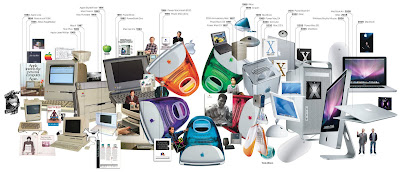
Wired have revealed a wonderful visual timeline showing the evolution of Apple products. 

Although I am aware of Apple's history and their legacy of products and services, this visualization made me realize not only how they have progressed over the past 25 years, but also how quickly.

This needn't apply solely to Apple. This image is testament to a changing world.

Context and cohesion: How can timelines be used as a communication visualization? What can they show? Can a storyboard be defined as a form of storyboard? 


Monday, March 2, 2009

twitter story

This communicates Twitter beautifully.

The simple hand-drawn graphics really reflect the simplicity and practicality of Twitter.


How can this method of story telling be used to communicate more complex information?

Follow me on Twitter: twitter.com/giorgio_giove


Thursday, February 12, 2009

interactive comics and biological consideration

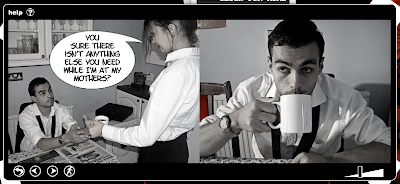
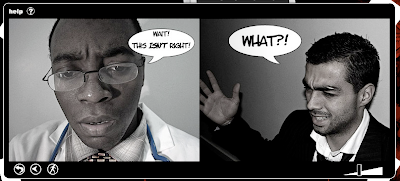
Dead On Arrival is an interactive comic loosely based on the story of the old 1940s film noir. 

Although I found this story rather dull, indolent and unexciting, the story was delivered clearly and the Flash interaction was well executed. This makes me think about communicating ideas to people through storyboards and story telling. 

I discussed with my study advisor, Dr Shaleph O'Neil about how people may react to certain storyboards. There will be 3 different types of storyboard: 1. Hand drawn 2. Graphically illustrated  and 3. Interactive.

The interactive storyboard will obviously be digital, however as Dead On Arrival shows, Flash animations can contain very "un-digital" and natural interactions. For example the turning of pages; this is done by clicking the top or bottom corners of a page and dragging them over, almost as you would do a book.

Computer interactions can be very natural. This reminds of the beauty of the interaction design of an iPhone or iPod Touch when zooming in and out of photos or web pages. Pinching your fore-finger and thumb together, a natural human gesture for describing the reduction in size of an object, is how to zoom out (i.e. to make smaller), and vice-versa.

How natural can I design interactions?

I don't mean to compare an iPhone with a digital comic, however the principle of their interactions are comparable in terms of natural gesture. There is biological consideration into their design. 

Click here to see the Dead on Arrival comic. An HTML version of the comic is also available, which I think is rather pointless. The whole beauty of the story is the interaction itself.

Tuesday, February 10, 2009

daily routines

I don't know why I hadn't blogged this weeks ago! It came up in conversation yesterday and reminded me.

Daily Routines are taken from magazines, websites, books and newspapers and depict how writers, artists and many other interesting people live their days with the little rituals that make each and every one of us that little bit different. 

The chronological blog entries allow you to compare different people from the same discipline; authors for example. 

Two of my favourite authors' daily routines are mentioned on the blog:

Stephen King

“There are certain things I do if I sit down to write,” he said. “I have a glass of water or a cup of tea. There’s a certain time I sit down, from 8:00 to 8:30, somewhere within that half hour every morning,” he explained. “I have my vitamin pill and my music, sit in the same seat, and the papers are all arranged in the same places. The cumulative purpose of doing these things the same way every day seems to be a way of saying to the mind, you’re going to be dreaming soon.

“It’s not any different than a bedtime routine,” he continued. “Do you go to bed a different way every night? Is there a certain side you sleep on? I mean I brush my teeth, I wash my hands. Why would anybody wash their hands before they go to bed? I don’t know. And the pillows are supposed to be pointed a certain way. The open side of the pillowcase is supposed to be pointed in toward the other side of the bed. I don’t know why.”


John Grisham

When he first started writing, Grisham says, he had "these little rituals that were silly and brutal but very important."

"The alarm clock would go off at 5, and I'd jump in the shower. My office was 5 minutes away. And I had to be at my desk, at my office, with the first cup of coffee, a legal pad and write the first word at 5:30, five days a week."

His goal: to write a page every day. Sometimes that would take 10 minutes, sometimes an hour; ofttimes he would write for two hours before he had to turn to his job as a lawyer, which he never especially enjoyed. In the Mississippi Legislature, there were "enormous amounts of wasted time" that would give him the opportunity to write.

"So I was very disciplined about it," he says, then quickly concedes he doesn't have such discipline now: "I don't have to."


I wouldn't have thought Grisham was so meticulous in his creative process, however considering he was a lawyer, this now seems reasoned. I also love the fact that King, writer of such beautifully horrifying stories, writes in such a pleasant, organised and warm environment. 

I think I might storyboard some of these!

Monday, February 9, 2009

hypercomics


In reference to the concept of hypertext fiction, where narrative is non-linear and non-hierarchical, hypercomics are a variation of comics that has truly embraced its digital medium, allowing multiple changeable paths within a fractured rhizomatic (wiki) environment. 

A great example of hypercomics is a piece by Daniel Merlin Goodbrey entitled PoCom-UK-001. It was originally a massive collaborative hypercomic, however this web adaptation marked the debut of Daniel's "Tarquin Engine", a flash-based interactive canvas, which allows other authors to easily explore the concept of hypercomics.

Having spoken to my study advisor, Dr Shaleph O'Neil, about using Flash to animate storyboards, I instantly and naturally created an image in my head of how this animation/interaction would look. Having seen this, however, I now realize the true potential for variation interactive visualizations can possess. 


See more at http://e-merl.com/pocom.htm


Saturday, January 3, 2009

unique perception

Notes to self:

Can
storyboards be produced using images alone; without the use of written language?

Roland Barthes in his essay "Rhetoric of the Image" (cir. 1964) argues that the meaning of an image is always related to and dependent on verbal text. He believes that images alone are "polysemous." In other words, too open for interpretation.

Does written language always have to rescue an image?

The definition of 'comics' suggests that written language is not necessary to accompany an image or sequence of images. (For sure, a comic and a storyboard are not the same form of visual communication, however they do have their similarities).

A visualization can be interpreted in different ways depending on the opinion/stand-point of the viewer. 'Similar Diversity' (below) is a wonderful example of this.

But isn't that the beauty of visual arts? Our eyes see the same things our minds interpret things differently. 

Friday, December 19, 2008

stick figures with body language

I found a website which is series of Stick-figure comic strips featuring humour about technology, science, mathematics and relationships. Not the most common of themes you would associate with humor.

I am interested in the actual stick figures themselves. The illustrator(s) give a wonderful insight into the personalities, moods and emotions of the stick men by the way in which they are drawn.


I love this cartoon. Besides the dialogue between the 2 characters being so randomly funny, it's the characters that make me laugh the most, just by how they are drawn. 

It makes me think about visualization, and in particular storyboards, in the design process. A picture can tell a thousand words, so they say, but in this case, a stick man can do exactly the same!

See more at xkcd.com

Friday, November 14, 2008