Showing posts with label technology. Show all posts

Tuesday, March 3, 2009

unawareness to evolution

Introductions to new things, such as enhancements in technology, by chance, often deliver a more lasting memory or experience. 

I get, what I can only call "realization" moments when I haphazardly stumble upon something new.

When I saw this image, I had one of those moments.


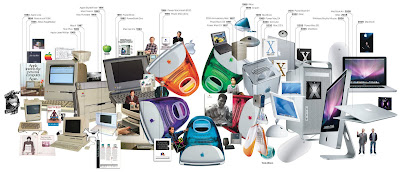
Wired have revealed a wonderful visual timeline showing the evolution of Apple products. 

Although I am aware of Apple's history and their legacy of products and services, this visualization made me realize not only how they have progressed over the past 25 years, but also how quickly.

This needn't apply solely to Apple. This image is testament to a changing world.

Context and cohesion: How can timelines be used as a communication visualization? What can they show? Can a storyboard be defined as a form of storyboard? 


Saturday, February 21, 2009

iBirth

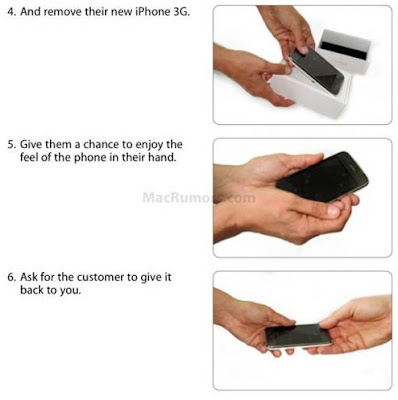
Having already covered iphone "romance" I had to post this... (from macrumors.com)


"...the process that iPhone sales folks are instructed to follow verrrry closely mimics - wait for it - childbirth. The uncanny point of similarity is that, in between purchase and the required in-store activation, the salesperson is instructed to "give them a chance to enjoy the feel of the phone in their hand," and then "ask for the customer to give it back to you." It's just like that first quick cuddle that the new mother is allowed with her child, before the kid's taken back for a thorough cleaning. And hey, why not? The iPhone is, for lack of a better term, an "intimate" product that's meant to be held and which will be an important part of its new owner's life. Without first letting the customer "enjoy the feel" of it, there might be detachment issues, postpartum depression... and I'm only half kidding, here. It's insightful of Apple to have provided this experience for the customer, a very user-friendly one that they can add to their repertoire of user-experience competitive advantages..."

This makes me think about the work by Richard Banks where he looks at what it means to design digital artifacts with longer time spans in mind, and taking heredity of objects into account. Apple have obviously considered the birth of the product with the iPhone, but how have they planned the funeral of it? 

Will the grip-reaper of digital products touch each iPhone at the end of its life; cracking the screens and malfunctioning the software? Or will the iPhone live on beyond its owner to entertain and serve a new generation?

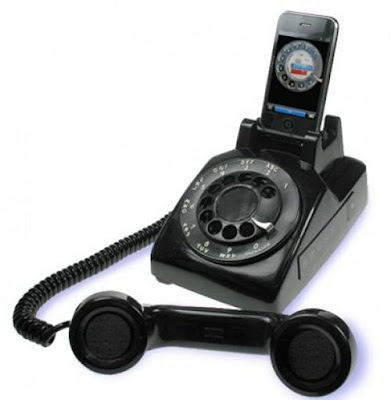
Will the iPhone ever be "retro"? 


Friday, February 20, 2009

visualizing networks

Going back to my research into visualizing complex information; Burak Arikan, artist and researcher, studies the way people interact through communication.

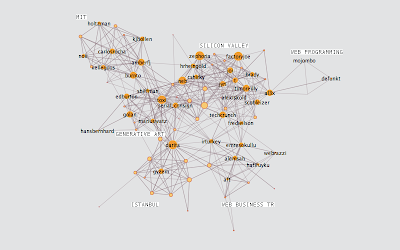
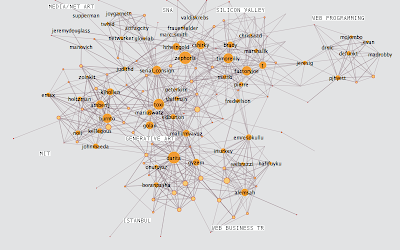
This following piece of work is wonderful. He carried out an experiment with the Twitter API where he analyzed the growth of his own network over a period of 3 weeks.

week 1

It appears he was trying to figure out how connections might evolve and expand (or indeed contract) over time.

The above image (from his blog) shows his Twitter network during the start of the first week of his experiment. He mapped the connections between his friends and then broke people into 6 groups.

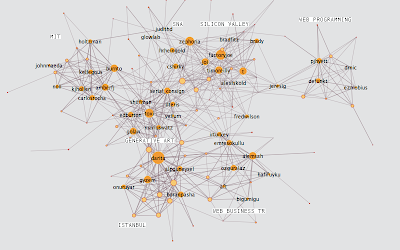
The next images show weeks 2 and 3:


Do people mind about these diagrams? It may reveal a lot about their privacy, which is potentially dangerous when you consider all the data is public.

I was thinking about carrying out a similar experiment with people within a work environment for the benefit of my research. Who talks to who in the office? In which way do they communicate (email, in person at the water cooler, telephone)? 

Communication can be a problem in the office. Bottlenecks can be created; It is also known for people to communicate through email, even although they sit next to one another. 

Where can ubiquitous computing come into all this? Can there be an invisible communication tool in the work place that can seamlessly fit into the daily rituals and lives of the employees?

It is naive and simplistic to consider ubiquitous computers will be adopted by people in any scenario. It's all about designing around the people.


Thursday, February 19, 2009

livescribe

Amazing IC product, livescribe.


Here's a quick demonstration by IIT Institute of Design professor Tom MacTavish, of the Livescribe digital writing system, a pen-and-paper duo that records audio, remembers what was being said while you were taking notes, and affords some basic computing function in a wholly analog format. If that sounds confusing, just check out the video; MacTavish does a great job of showing it off.


richard harper

The down side to drafting into a word processing document and then copying/pasting into my blog is that sometimes I forget to actually copy and past into my blog! This following post has been sitting dormant in my computers hard drive... until now.

"
Professor Richard Harper from Microsoft Research, Cambridge, spent a morning with us to discuss how people of various disciplines see the world we live, and how this can cause problems in the design process.

He began by talking about how we gossip and how this act can be translated through metaphor into solutions for design problems.

I found this notion very refreshing as it coincides with work I have done in the past on touch-screen systems. My ideas for interactions were all based on human gestures I took as metaphors and used to act as inputs for computer systems. Richard calls this language (or method?) "Human Acts."

Richard's advice was to be aware of the difference between ourselves (designers) and others, such as scientists for example. Designers show their portfolios to other designers but seldom do they communicate their work from people outside of our discipline. He suggested we must have trust in other people and don't show them only the finished article. The process behind the finished article is often more interesting; so is communication of design all about telling a story rather than showing an artifact?

I agree with Richard. Whilst exhibiting my honours project work at the Degree Show and then New Designers, people were more interested in how the project materialized over time and why I made the decisions I did throughout the process. This was, at the time, a little disheartening in a way as I wanted people to be in awe over the prototype that I spent so long getting right. Instead, all they wanted to do was to ask questions and, I suppose, understand me rather than what I made. All I had to do was tell my story.
Richard Banks' advice is not to get to precious about prototyping; and this is probably the most valuable piece of wisdom I've taken on board since I started my Masters.

After spending an hour or so with Richard Harper, we were lucky enough to be invited to his evening lecture, entitles "Changing Humans." Here, he explained how the designers of computers and computer systems have changed their visions of users.

People love to gossip and communicate with each other. People network themselves naturally and now also digitally, through the introduction of text messaging and video messaging (and subsequently social networking sites like Facebook). The metaphor of gossiping is what inspired ideas such as video messaging; a tool that enables people to send friends videos, presumably to make them laugh.

The morning session and evening lecture made me think about a lot of things to do with common languages between people in different disciplines and interaction design in general. But the most valuable theory I took from today is all to do with language. Language is the key tool that we can use to communicate and be understood as designers. We can achieve this by applying metaphors and other language sub-tools. Language is the only common ground we all have.

"


Wednesday, February 18, 2009

how romantech

An example of personal technology?

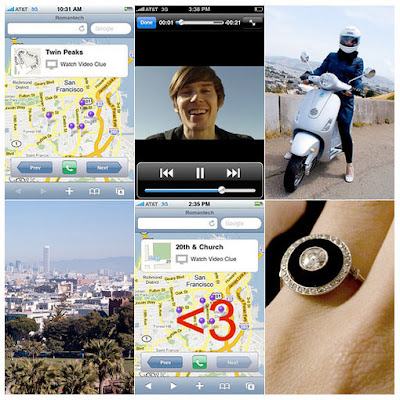
User interface designer Bryan Haggerty, programmer at LinkeIn, proposed to his girlfriend Jeannie Choe, former writer at Core77, with an iPhone application which he deigned himself.

It was last week that he popped the big question, but only after having his girlfriend guided through a route in San Francisco by the iPhone app. 

The app, which Haggerty calls "Romantech", displays a map containing location points throughout San Francisco. Each of the points in the map were tagged with a short video clip of Haggerty giving little clues of where Choe should travel to next. 


After a while, both met in a Park where all the points on the map connected to form the shape of a <3>

(The <3 is a heart symbol for those of you who don't know the lingo)>


Monday, February 9, 2009

death, inheritance and heirlooms


I had an interesting conversation with Richard Banks today over lunch.

Richard has been looking at what it means to design digital artifacts with longer time spans in mind, and taking heredity of objects into account. He explained his interest in the design of a form of technology which he refers to as technology heirlooms. 

In my understanding, a technology heirloom is a technological product/object that is designed with the intention that it might live longer than its owner and therefore be "handed down"  embodying an impression or sense of its owner. (Richard, please correct me if I am wrong!)


Digital objects are normally thought of in the short term. But Richard is now asking what happens when we consider these objects in the long term that may have unpredictable and unexpected value to our children and families. 

I find this notion of digital objects being un-obsolete (have I just made up a new word?) fascinating. If I were to pass my iPod down to one of my grandchildren, how will they perceive it? Will they keep it in a shoe box under the bed as they feel obliged to keep it but not to use it? Will my (varied) music collection be loved or hated? Will my iPod still be "cool"?

What will "retro" designed object look like in 2109?


Death is something we all experience whether it be through bereavement or through the approach of death itself; it is part of life. Considering digital products may outlive their owners introduces a whole new principle in the way we design objects themselves; design for the dead?

Which leads me to think: Who will I pass my Facebook profile onto?


Sunday, November 23, 2008

ethnography study: is online time "good for kids?"


I have a Facebook account which I use now and again, and I find it very useful for keeping in touch with friends whom I may otherwise have lost contact with. It's true, if Facebook did not exist then I would have lost touch with some friends from High School, so why use this new tool as a method of communication with people I would otherwise have forgotten about? 

I suppose in a way it makes me happy to keep in touch with these people. After all, these friends from the past are tagged with many memories, some of which would have evaporated if it weren't for the occasional email from them to my Facebook homepage.

However my opinion of social networking sites is not all that of hope, happiness and reminiscence. children and teenagers are spending far too much time surfing the internet and socializing online through the likes of Facebook and MySpace. 

There are many dangers related to these past-times such as childhood obesity and the risk of meeting pedophiles disguising themselves as teenagers through the mask of the virtual world. In fact,  25% of 8-15 year olds in the UK admit to having "Facebook" friends; people they have not met in real life but have befriended through the social networking website.

However this morning I read how a study has shown that spending time on social networking sites is important for teen development. 

The report really counters my opinion and probably the stereotypical views of parents and teachers nationwide.

"They are learning the technological skills and literacy needed for the contemporary world," said Dr Mimi Ito, the reports author. 

"They are learning how to communicate online, craft a public identity, create a homepage, post links. All these things were regarded as sophisticated 10 years ago but young people today take them for granted."

The aim of the Digital Youth Project was to provide an ethnographical view of how children use social media to socialize, learn and relax. More than 800 teenagers took part in the study.

Dr Ito also says that the internet provides teenagers the opportunity to explore in their own creativity whilst providing a "hang-out" place for teenagers, rather than public places where some are perhaps likely to cause nuisance or even commit petty crimes.

This has made me realise that there are opposing advantages and disadvantages to online socializing. On one side we can argue that children are not getting out enough to exercise, for example, as they spend so much time in front of a computer screen; surfacing issues such as childhood obesity which then leads to health problems in later life. There is also the danger of children not always knowing who exactly they are talking to online. 

However the on the other side, the argument is more related to the younger generations ability to use technology and explore their creativity. 

As a designer interested in technology, it would make sense for me to now argue for the latter, however I am indecisive (for a change) and find myself swaying between both arguments. 

So here is a final thought: "Modern" learning has become very peer-based and networked, so with more teenagers now possessing technical abilities partnered with creative thinking, will this path the way for a new breed of designer?
Tuesday, November 18, 2008

evolution of design during financial turmoil


I was speaking to my 1st year students on Friday about where their research is taking them for the G2 project. A lot of the students are looking at the current financial crisis and how the coming years of financial struggle will have an effect on design.

One student has really focused in on a specific topic regarding the credit crunch and is looking at how "high-end" design will be effected however I am more curious as to how design will evolve over the next few years.

There is no doubt that the challenging economic environment is going to have a huge effect on everyone and everything related to design world wide. Economists say that with so many families in the UK in debt and negative equity, people will no longer be able to afford the luxuries we are so often used to buying.

When people stop spending, companies stop making money; simple. So in terms of products, gadgets and sophisticated developments in technology; what will we be being sold in 5 years time?

More importantly, are design and technology about to change they way they have evolved of the past decade?


I love this image (above). It illustrates just how much both design and technology have evolved over the past 20 years or so. And the image below shows how little time it takes for a designed object to become obsolete and aged. 


In an ever changing financial environment with economic restraints, in what way will the ideas, thoughts and opinions of designers have to change in order to design for people who don't have the money to spend?